Saturday, June 14, 2014

June 14, Saturday - Hiking around the Galilee area

Surprise, surprise…. Another busy day for us.  Up at 6, breakfast at 7, on the bus at 7:30, hiking by 8.  If you are looking for a relaxing vacation – THIS IS NOT IT! But if you want one that will challenge your mind, soul, and body I don’t know that you could find a better trip to take.

Part of the trail
Our first stop today was Mount Arbel.  It stands about 2700 ft above the Sea of Galilee and we started pretty close to the bottom.  It was a steep climb to say the least, so much so that parts of it had metal hand holds which had been pounded into the rock so you had something to grab on to and also step on as you climbed. 

Part way up the mountain we came across caves.  These had been used by Jews who were fighting Herod in 43 BC as a place to hide their families while they fought.  Eventually the Romans found them and massacred them.  Now 70 years later Jesus is telling the descendants of those murdered to love your enemy.  Jesus was not bringing an easy message to this area.  It is sometimes just as hard for us to accept this today.

Each of our hikes is also meant to help us experience something of ancient times and John explained that rabbis of the time of Jesus often would come here to be alone to pray and think before starting their day – another indication that these guys were in great physical shape if this is how they start their day!  This is where scholars believe Jesus gave his disciples the direction to ‘go out and make disciples of all the nations’. 
Caves along the trail


Looking back down
From the top of this mountain we could see the main area where Jesus taught.  They estimate that 80% of his time was spent in the northern section of Galilee primarily because there were devout Jews in the area who were waiting for the Messiah and the concept of a rabbi and discipleship was practiced in this area.


One of the main cities he taught in was Chorazin.  It was a small typical city around Galilee where one of the main things they did was to make olive oil.  It also had one of the oldest synagogues uncovered in Israel.  We studied the various elements of a synagogue (ritual bath area before entering the synagogue, Moses seat where the person scheduled to read from the Torah would sit, place from where the Torah was read, etc.). 

Looking into synagogue from entrance
One of the things which each synagogue would have was a school room attached to the back or side of the building.  It was here that young children would study Torah until age 12.  At that point if you were a boy you would either start learning your father’s trade or, if you were gifted in studying scripture, you would continue studying until about age 15.  At that point you would either start working the family business, or you could ask a rabbi if he would take you on as a disciple.  If you did not find one, then off to work.  By about 18 you would then get married.  The significance of this is that, as we discussed, only Peter was married so that could well mean that Jesus picked (and it was rare for the rabbi to pick the disciples) teenage boys who essentially flunked out of religion since they were working with their families.  It was this simple group of boys who carried his message throughout the area, eventually reaching the whole world!  


Hill beyond the trees is sight for feeding 5000
Bethsaida was a fishing village (the name actually means house of fishing) probably right on the Sea of Galilee (the shoreline no longer comes right up to the village).  All of these villages were fairly small with only 400-500 people living in each.  What is remarkable is that Jesus called Peter, James, Andrew, John, and Phillip from here!  It was just a short way from here in one direction that Jesus fed the 5000 and a short way the other direction where he fed the 4000.  So of course this is where we ate lunch. 

We discussed the section of the bible where Jesus’ disciples are discussing the fact that they had forgotten to bring bread on one of their trips and they only had 1 loaf and worrying about what to do. (Mark 8: 13-21)  Jesus said: Didn’t I just feed 5000 with 5 loaves and 4000 with seven?  Don’t you get it yet?

Jesus was not saying that he could easily feed them with the 1 loaf but that we don’t need to worry about the more mundane things – He knows what we need and will provide it.  We just need to trust in Him.  In other words – don’t sweat the small stuff (and most is small stuff)!

After lunch we drove over to a place where you can reach the Jordan River.  Don’t let the name fool you, it is more like the Jordan stream.  John said that except for flood stage during the rainy season this is pretty much what it would look like.  During the time of Jesus water signified chaos or the devil.  When water is described in the bible it often involves storms or other trouble or danger.  By coming out of the water, John’s baptism signified coming out of the chaos into order.

Me in the Jordan River
John told us how his children were baptized in the Jordan last year and he called any of us who wanted to be baptized to come on in (he was standing in the water at this point).  He also said that normally the person would have gone out into the river themselves, gone under the water, and come back out.  So he also invited any of us who wanted to do this to also feel free to do it.  Several of our group went out with John to be baptized and others of us re-dedicated ourselves to God by immersing ourselves in the Jordan.  Even for those who did not feel moved to go into the water it was a wonderful time of fellowship.

A cool spot for bible study!
We talked about how every time you make a choice in your life that cannot be undone (getting married, having a child, etc.) you are essentially reborn because you start a totally new life.  It is important to keep God in all your re-births, not just if you consider yourself reborn in Christ.

As if we did not already have enough to think about this day (it is already taking me 2 days to summarize it!) we still had two more lesson sites to visit.


Harbor area where Simon was fishing
The Tabgha Springs is a location at the edge of the Sea of Galilee where local fishermen would come to rinse their nets when they were done fishing.  This is because there as a group of 7 springs in this area which provided clean water plus it was located in a natural harbor area.  Simon was here with his partners James and John cleaning there nets when Jesus came by.  Jesus had already raised someone from the dead and performed many other miracles so there was quite a crowd following him.  He asked Simon to take him out in a boat so he could teach out a little from the shore.  When He was done he told Simon to lower his nets to fish.  They had fished all night but not caught anything but when they lowered the nets they caught so many fish it almost sank 2 boats.  They were both amazed and afraid but Jesus reassured them and asked them to follow him as disciples.  I always wondered about the part in the text where it then said they dropped everything and left to follow him.  But as John explained – here was the ‘rock star’ rabbi of the period asking them if they wanted to be his disciples (remember, rabbis did not ask disciples to follow them, boys would ask to be a disciple).  I can now imagine them jumping at the chance before Jesus changed his mind. 

Our faith lesson was to learn to leave behind anything which keeps us from following Jesus in our life.
The Spring
Our final stop for the day was actually just across the street from the Tabgha springs.  Along with being a natural harbor, the hillside forms a natural amphitheater.  This is the traditional location for the Sermon on the Mount.  We discussed how Jesus would not have instructed his disciples in all of these things all at once but instead they would have spent quite a lot of time going over each point.  It may be that this was a favorite spot for Jesus to take his disciples to discuss these various topics and that often there would be crowds who followed to listen in.  The gospel writers may have just grouped all these teachings together as if it was one long sermon.  Perhaps the better title would be teachings on the mount. 

We also discussed the story of the Prodigal Son and how the father actually had 2 sons who were ‘lost’ in terms of their obligations to him.  The first by wanting his inheritance right then and the second for being resentful when his brother returns and not helping his father rejoice. 

Inside the Church of the Beatitudes
As the rest of the group headed back to the hotel I did a little extra hiking out to the Church of the Beatitudes.  I thought I might be able to find them having Saturday evening mass but arrived to find them about to close to tourists for the day.  They were nice enough to let me in for a quick visit since I had obviously hiked up there (nice way to say I was pretty dirty and sweaty with my hiking poles in hand).  It was refreshing to sit in the church (more the size of a chapel than a church) and read parts of the Sermon on the Mount teachings.  The only bad part of the extra hike was about 50 yards of weedy field I had to hike through after leaving the road.  (I was still feeling that the next day with all the small scratches – but it was well worth it.) 


Church of the Beatitudes


The hotel was within walking distance but the extra hike added about 2.5 miles to my day.  Not counting that side trip we hiked 4 miles today (mostly up hill) for a total of 25.75 miles so far.  I suspect that I have a shorter stride set on my pedometer than I’ve actually been walking and hope to double check that in the next day or so.  I’ve been recording the number of steps per day so if I find that this is off (seems low based on how my feet feel at the end of the day) I’ll post the updated distance.

Some additional pictures:
Some of the excavation work at Bethsaida is being done by people from the University of Nebraska at Omaha and some of the finds are also on exhibit there.  This is the sign that says this.  Bryan and I were surprised to find a reference to Omaha way out here.  


(NOTE: Text, links, and photos are complete for this day.)

Friday, June 13, 2014

June 13, Friday - Merry Christmas!

It may get difficult to keep up with things for the next few days.  We are now in the Sea of Galilee area and not only was today a busy day but I know the next few ones will be very busy too.  Coupled with no internet connection for part of last night I’m still catching up from yesterday.  I did finish yesterday’s blog.  If you looked at it any time before noon on Friday (the 13th J) you probably did not see all the pictures.  I have all of those up there now.  I’ve also decided to start listing at the bottom of the day’s blog whether or not I’ve finished the text and photos so you know if you should check back later.

Main Cave area
Ok, on to today’s adventures!  We covered 6 different sites and still walked 4.5 miles on top of that so we were busy, busy, busy.  One of the things John normally does not do is to visit any of the churches.  He wants us to get a sense of how things were in the time of Jesus, or whoever the subject for the site may be.  So instead of visiting the church of the nativity as a group, he took us to a similar type of cave this morning.  These types of caves can be found all around the area.  The best way to describe how they look is that they are similar to a large pita bread cut in half and opened up.  They have a wide opening, lowish ceiling, and do not extend that far back.
'Manger' area similar to where Jesus was born!
The purpose is to provide a sheltered area for the sheep and they often had a water trough cut into the rock where the shepherd could put water for them.  As you can imagine it was not the cleanest of places with a rather distinctive odor.  It was here that we discussed Jesus’ birth.  We started by focusing on when it might have taken place.  The only thing we know for certain is that it was not on Dec 25th.  I won’t go into detail about how that date got chosen, but generally birthdays were not considered significant enough to be mentioned by date.  But there are a lot of clues as to when it might have been.  There is a 5 mile stretch of land near Bethlehem specifically called ‘the fields’.  It is used for growing barley and wheat.
Entrance to the 'pita bread' cave
Once they are done harvesting the wheat, the shepherds are allowed to bring their sheep into the fields to finish cleaning up what is left.  Kind of a win-win situation in that the farmers get their fields cleaned and fertilized and the shepherds have an abundance of things for their sheep to eat so they don’t have to take them all around to find enough to eat (remember how barren the hills around there normally are).


The bible also says they were keeping watch over their sheep at night.  Normally they are kept in a rock walled pen at night and the shepherds can then sleep.  However just prior to major feast days they are required to constantly watch the sheep which will be used for sacrifice to ensure that they stay pure.  So based on these clues we know it would be after harvest which puts it in the June-Nov timeframe.  In the Sept-Oct time there are 3 feasts (Rosh Hashana, Yom Kippur, and Sukkoth).  John feels it was at the time of Sukkoth that Jesus was born, but at 11 at night I can’t recall why of the 3 he felt that was the one (he did his masters thesis on the birth of Jesus so I’m sure there is good reason), but I’ll ask tomorrow and post an update.  (Update: John feels it was Sukkoth because that is the feast of first fruits and when they pray that God will provide what they need and Jesus is living water. But it could be any of these 3 feasts and not change the message that Jesus came to show us how to live in the Father.)

So we have a date, as for the place we are fairly certain that the church of the Nativity does mark the spot because when Romans took over the area the local people had already been honoring that site as the location for his birth (they were also honoring the site where the church of the Holy Sepulchre stands as the place of his death, burial, and resurrection).  But the main points that John wanted to bring out is that there could not have been a more humble (think dirty, stinky) place for the Messiah to have been born.  But he loved us enough to come to us as a most lowly person to show us that we are all capable of following in his steps.  We ended our visit to the cave by singing Christmas carols.
Well and Manger still in use
The Judea n Wilderness
From here we moved further into the ‘wilderness’ to a location thought to be the area where Jesus went to after his baptism by John.  It says he fasted and prayed for 40 days, after which he was tempted.  40 is the number almost always used to symbolize a period of preparation and it is during this time that Jesus prepares to begin his ministry.  We also see in the bible that after the preparation time is a period of temptation (kind of like finals after you have been studying).  We discussed how God tests us so we know our strengths but the devil tempts us in our weaknesses to try to get us to fail.  The challenge is to recognize our strengths in order to resist giving in to our weaknesses.

We Hike along
It was now about noon and we were about to begin our big hike for the day.  I’m guessing it was easily in the upper 90s if not hotter.  We were getting ready to hike about 2 ½ miles along the Jericho road down to Jericho.  John gave us 3 options – take the bus down to the meeting place, ride a donkey along the trail, or walk it.  We had some people for each option.  I decided to walk it.  This was the one hike from the last trip that I had not been able to finish (I took a donkey ride for the last part last time).  I was determined to do it this time.  I might have gone the donkey option if we were walking from Jericho back to this spot.  That is what we did last time and it is up hill going that way – with the steepest part right at the end.  But even though this was the down hill direction it was still a tough hike.  There is no shade along the way and you are generally carrying extra water with you so that also weighs you down. 

About 1/2 way along

Jericho in the distance


The significance of this hike is that this is one of the main routes to Jerusalem and one that we know Jesus walked on his way there just before he died.  This is also believed to be the road used in the parable of the good Samaritan.  In that story it talks about how 2 different priests walked past the man who had been beaten up and left by the side of the road.  Walking this road you see it is pretty much just a narrow path (maybe 3 ft wide) with a steep drop-off on one side and the hill going steeply up on the other.  This means they would have had to step over him to get past him.  People of the day would have understood this because they also would have used this road frequently. 

It was awesome to walk this same path as Jesus and his disciples and contemplate what they might have thought about or discussed as they walked along.

Everyone did a great job in finishing the hike and I was pleased to have been able to do it and still have some energy left at the end! 

An old Sycamore Fig
Once we arrived in Jericho we refreshed with our now standard pita bread, humus, meat, and cheese sandwiches and headed off to central Jericho.  Our first stop was at a large sycamore fig tree.  This figures into the gospels as the place where Zacchaeus, a tax collector and short man, climbs a sycamore fig tree so he can see Jesus as he passes through town.  When Jesus calls him down to say he plans to eat at his house, the Sadducees (many of them liked to live here) talked about how wrong it was for him to eat with a sinner (they did not think highly of tax collectors).  Jesus uses this opportunity to explain how he came to save sinners and at the same time used parables to scold the Sadducees for not being faithful to the laws passed down from Moses.  Our faith lesson centered around the fact that we do not need to be always worrying that we are being as productive for God as we can, just that we be faithful to how he wants us to live our lives and He will do the rest.

We Circle Jericho
Jericho was the first city the Israelites encountered as they entered the Promised Land.  The city was (like most cities) surrounded by a high wall for protection.  God instructed them to walk around the city once a day for 6 days on on the 7th day, walk around it 7 times and then blow their horns and shout to God.  They did that and the walls fell down and they captured the city.  We began by walking around Jericho ourselves.  It only took about 15 minutes so imagine how many blocks you could walk around in that time and that is about the size if the old city of Jericho.


Jericho Ruins
Once they captured the city God told them to not take anything from it and to continue on into the Promised Land.  This would have been a hard thing for them to do because they have just spent 40 years in the desert and Jericho is an oasis town with lots of trees and probably great farmlands.  But God asked them to trust him that he had better things in store for them.  The faith teaching is that we too should give God the first/best we have whether it be our time, talents, or treasures as a way of showing that we trust Him to in turn give us even more of what we need.  It made us think about how many times our religion is something we fit in when we have the time rather than fitting in the rest of our day around living our faith.


Fountain from Elisha Spring
Elisha Spring
Another major event to have happened here is that Jericho was the city where Elisha returned to after Elijah was taken up in chariots of fire (not the movie).  He finds that the water is bad for drinking in the town spring.  He asks for salt, throws it into the spring, and the water is now clear and clean.  It continues to flow with fresh water today.  We ended our day of teachings by sitting alongside this spring and letting our feet enjoy the cool water.


The end of day 6.  Today was one of the longer hiking days with 4.5 miles of hiking.  That means the trip total is now 21.75 miles.  Tomorrow should put us over the 25 mile point! Not that distance is any indication of how much we see or learn – just another aspect of the trip.

(NOTE: The text and pictures are finished! )


Thursday, June 12, 2014

June 12, Thursday - Lowest Point on Earth

Ibex greating us at the entrance
Today we arrived in Ein Gedi – the area where David fled to when Saul was out to kill him.  It is out in the desert region just next to the Dead Sea.  In order to beat the heat of the day we started out at 6:30 this morning, getting there when it opened at 8.  The hike is in 2 parts.  The first part we walk out to the base of one of the waterfalls (more about them later) and do bible study about David and Saul as well as the waters here.  Then after that, people have the option of returning back to the park entrance or continuing on.  Continuing on means continuing to climb up the steep trail to the top of the ridges (about twice as high as we climb to the falls).  You do need to be fit to do this, but John’s speedy pace makes it all the more challenging.  It also means spending another 2-3 hours in the heat and sun.  Today the decision was made by the park rangers for us.  Because of the predicted heat they closed the trail above the falls and we all ended up returning early.  I have mixed feelings about this since I do know that there were other interesting things along the way, but then I definitely was grateful to not have to endure the heat and the climb.

Caves
But back to the hike we did complete.  All throughout the area is limestone which is prone to forming caves.  Cliff note version: - It was in one of these caves that David was hiding with some of his men when Saul came into that same cave to ‘relieve himself’.  While he was in there David snuck up and cut off the corner tassels of Saul’s robe.  When Saul left the cave David called out to him and showed him the tassel, saying how if he intended to hurt Saul he could have easily done it right then but that as God’s anointed one David respected Saul.  Saul recognized that he was wrong to try to kill David and took his men back to Jerusalem.  It was awesome to sit right in the area where this climax played out reading the account in the bible!  Charged up after reading the story we continued our climb up the ridge.

Looking down the wadi to the dead sea - note how high we are!
The valley area we were in is called a Wadi and sometimes has a spring flowing through it (as in this case) or it may just be a pathway where flood waters flow through in the rainy season.  In any case, it is one of the few places where you will find things growing.  It was a relief to be in the desert, but still have the opportunity for shade under a tree as we walked along. 


Waterfall (duh) - with 2000 yr old water


We arrived at the falls and found the last of the morning shade to sit in while we discussed Jesus as the living water.  The water is spring fed, originating back in the Jerusalem area, percolating down through the limestone, and following cracks in the limestone before reaching the surface again here.  It is cold, clear, and refreshing!  It is also 2000 years old!  That is how long it takes the water to make the slow journey through the rock aquifers before reaching this place.  We talked about how this water may have fallen as rain on Jesus when he was first instructing his disciples and now emerges to refresh us as we sit studying those same words.  We also talked about how we need to be refreshed throughout our lives and Jesus calls us to also take his word as living water to others to help refresh them.

I’ve heard that the link to this blog has been passed along several times now and you may not even know me – but most likely you do know someone on this trip.  There are 32 of us trying to follow John as our rabbi for these 2 weeks as we learn new insights into the word of God.  But you are also with us in very special ways.  Each day we start the day by praying for loved ones back home who might be going through some difficulty.  We also meditate on how you ‘refresh’ us, and pray for those who we may not even know are struggling with faith.  When we get back, we need you to ask us about the trip, challenge us to explain why we came and how it changed us, help us bring the living water from the desert out into our communities.  We are all constantly working to grow in faith and may need help in seeing how to make this come alive for you.  Perhaps we will even inspire some of you to take this same type of trip!


Bryan - All In!
On the way back down to the entrance we passed another smaller waterfall.  John had already fussed at us on this hike for not following his example in how to cross a small stream.  (Part of this trip is to understand what the disciples of Jesus would have done as they followed Him.  A good disciple does what the rabbi does and then later waits to see what the reason for it is.)  So when he jumped into the pool beneath the falls we all followed.  As we sat there in the water (hiking shoes and all) we talked about how as Christians we are often timid and not ‘all in’ when it comes to living our faith.  Despite our initial concern with this impromptu soak, it really did turn out to be a great blessing.  We were cool for the next few hours and our shoes got a well needed rinsing off.  Further demonstrating that when God calls us to do something, we should trust that we in turn will be blessed.


Does this really need a caption?
We left the park shortly after this and drove just across the road to the Dead Sea.  There were no bible stories to discuss here (although the Salt Lake is mentioned in the gospels) but rather just a break in the day.  I did not go in (did that last time) but instead found rocks with salt on them to bring back (no surprise to those who know me).  The Dead Sea sits at the lowest point on earth (not counting ocean bottoms) at 1400 ft below sea level.  This increases the amount of oxygen available but also the heat.  It was 42 Celsius at the ‘beach’.  That is 108 Fahrenheit. So I don’t care how much extra oxygen you have, hiking is still a challenge!

A quick shower for those who floated in the sea and we were back on the bus to the last spot of the day – Qumran.  This is where a group of devout Jewish priests settled after leaving Jerusalem after becoming discouraged by the behavior of the other priests.  They went to the desert to ‘prepare the way for the Lord’.  They were known as the Essenes.  It is believed that John the Baptist was an Essene and may have lived in this community based on the beliefs he taught and the fact he preached in this immediate area.  Their main mark on history is that they spent their time not only studying but writing copies of various books of the old Testament.  Copies found centuries later are knows as the Dead Sea Scrolls and are the earliest copies of these bible books.  We stood in the room where they believe the scribes wrote the various copies, trying to imagine the dedication needed to choose this lifestyle to study the word of God and prepare the world for His coming.  


Salt encrusted rock at the Dead Sea
And another day is done.  With our abbreviated hike, today’s distance was again just over 3 miles, bringing the trip total to 17.25 miles.  Tomorrow we will be heading to Jericho.  If we hike the same route as last time it will not be a terribly long hike, but very hot with no shade, definitely another day where we all look forward to that shower at the end of the day!

Here are some additional pictures from the day:
Large piece of salt from dead sea


These next 2 pictures show the barren landscapes we drove through on the way out to the desert areas.  As soon as you cross over the mountain tops the amount of rainfall drastically is reduced and from a distance it looks like totally barren land.  Remarkably we encounter flocks of sheep grazing on these hills!


Notice the city at the top of the hill and the farmland (with probably olive trees) at the bottom.

Wednesday, June 11, 2014

June 11, Wednesday - Samson, David, and Goliath

Not as much hiking today but we visited 5 different sites.  Plus we are getting ready now to head to the house of Abu Ali.  He is John’s bus driver when he has a smaller group and the brother of Abid – the driver for this full size bus we are using.  He must really like John to invite 35 people to his house for dinner.  We ate there the last time I was here and this is also no small dinner.  As a result, I don’t expect to get back to the hotel until at least 10PM our time tonight and we have to be down to breakfast by 6 AM and on the road by 6:30 tomorrow.  So, if there are no pictures with this entry yet – that is why.

Watch Tower
On the way out of Bethlehem we passed an area of terraced gardens and several old watch towers.  This is a picture of one of those watch towers.  It would have been used as a temporary home when the harvest was nearly ready so it could be guarded and harvested items stored in it until the harvest was complete.  There are several references to watch towers in the bible.


Timnah from Zorah
So first on the agenda for today was a visit to Zorah.  This is where Samson was born and raised.  Our teachings focused on how he was called to serve God his whole life but the temptations of the world kept drawing him away from God.  Even so, God continued to give him opportunities to live a life of example.  We had some great discussions on how the things in this world might not be what God wants us to embrace, but through our weakness we might give in – especially if we don’t have the support of a faith community.  Later in the day we would contrast how Samson did not have that support from others (they had to recruit men to attend his bachelor party) but David called on God for support and he provided people to help him in his faith. 

From here we traveled to Beth Shemesh which is mentioned in the bible as the place where the Arc of the Covenant was returned to the Israelites by the Philistines (who had captured it 7 months prior).  They returned it after each city which held it was hit with plagues.  It essentially became the hot potato no one wanted.  The interesting thing was that Beth shemesh, while thrilled to have it returned to them, also did not want it there in their city.  Our talks explored the idea that in the presence of something so holy it forces us to examine our own lives which can be uncomfortable.. 

Bottom of the cistern - looking up

walls of cistern - plastered to keep water in

Also at this location we had the chance to go down into a cistern.  This is a man-made cave cut into soft limestone which is then used to collect rainwater during the rainy season to help a community survive the dry season.  The problem is that by the end of the dry season that water is getting pretty nasty especially if animals have dropped into it and drowned.  The alternative was to find a place with fresh moving water.  This is called living water and is how Jesus described himself.  To the people of the times in this area that would have been a powerful description. 

Looking across the Elah Valley
We made a stop next at Azekah.  This was a short but intense hike which thankfully ended in a grove of trees and nice shade.  So many of John’s hikes start at the bottom of a hill (small mountain!) and go up and up.  Finally after the exhausting climb we reach the top where the bible study takes place and then we find that there is a parking lot up there with the bus in it! I doubt John will ever think it is as good to start at the top and hike down, but I can hope.

Azekah is the location for the battle between David and Goliath.  We stood on the hill probably used as the Philistine camp and looked at the hill of the Israelite camp with the valley in between.  We talked about how Saul should have been the one to fight Goliath, but that God had prepared David for this mission.  David had been a shepherd, throwing stones to move the flock in the direction he needed and this simple skill was used to defeat Goliath.  Likewise we may not know how our skills may fit into God’s plan but all of us are capable of great things if we leave ourselves open to the opportunity. 

Riverbed near battle of David and Goliath
Before we left the area we went down to the river bed running along the valley which is where David would have looked for the stones he took to fight Goliath.  It was funny to learn that so many tourists do the same thing that every year the Israeli government brings in fresh loads of stone to put in the river bed.  But I guess it is the thought that counts!


Cave at Adullam
After David kills Goliath he is praised as a hero – even greater than Saul.  Saul becomes jealous and tries to kill David.  David escapes and is thought to have taken refuge in caves near Adullam.  We visited the caves and read Psalm 142 which it is believed David wrote while there.  He called out to God for help and men from around the area came to join up with David.  This is the contrast to Samson who tried to go through life on his own rather than David's search for a community of people to help him.  I know a lot of folks who are good people and consider themselves religious but do not belong to a church they attend regularly because the 'don't get anything out of it'.  It is stories like this in the bible which help point out the necessity of having a community of supporters around us to really help us live our lives to their fullest.

That wrapped up the studies for the day.  We were all tired – mentally and physically.  Distance-wise it was an easier day with just over 3 miles of hiking, bringing the trip total to 14 miles.  Tomorrow we head back out to the desert and one of our more strenuous hikes.

First course of dinner
As a final wrap-up: we have gotten back from dinner at Abu Ali’s house.  We had a wonderful dish that was like a giant casserole with chicken, rice, potatoes, spaghetti, cauliflower, and carrots with spices that included cinnamon, cumin, turmeric, and probably a few others.  It was wonderful!  I had 2 helpings and then they brought out watermelon, then cake, then tea.  I ate until I sneezed and then some (inside joke).  I am going to try to get pictures uploaded tonight still, but we have to get an early start so bed cannot be too far off.


Tuesday, June 10, 2014

June 10, Tuesday - We scare a shepherd

Ok, note to self.  Do not eat an espresso magnum bar (especially when it says 'high caffeine') within 12 hours of wanting to go to sleep!  It took forever to fall asleep and then I never did sleep that well.  It did not help that the mattresses were very firm (firmer than the camper mattresses for those who know what I mean).  Luckily today was composed of a lot of smaller hikes and less heat.


Land of Abraham
We began the day by visiting Tel Arad near where we had been staying.  It is a site we visited last time I was here but I did learn more this time around.  This is within sight of where Abraham most likely lived at the time God made the covenant with him that his decedents would be as numerous as the stars.  The well at this location dates back to that time and he would have likely watered his flocks at this well.  It is so unreal to think about the various people who have lived in or crossed through this area for so many years!  We sat and studied the bible passages which talked about the covenant with Abraham but it took on such greater meaning being here where it happened!
Bryan at the Gate to the fortress.

At this location is a fortress and within it one of the only examples of a scaled down version of the Temple in Jerusalem.  Unfortunately it is being stabilized right now so that they can continue to excavate beneath it (everything out here is built on top of something else) so much of it was covered or we could not walk there.  You are welcome to look back to my visit in 2012 to see more about this site.


A stampede of sheep!
As we left the area we came across a shepherd tending a flock of about 50 sheep along the road.  If you have read any of the past 2 days and looked at the pictures you will see that these hills are far from what we would call lush.  Looking at them from the roadside you would think the sheep out here had adapted to eating rocks.  John always likes to find a shepherd and his sheep when discussing Psalm 23 so when we spotted them he asked our driver to pull over so we could go out and maybe talk to him about just what a shepherd does.  Now there are about 30 of us with about a 1/3 being basketball players over 6 feet tall.  Shepherds are normally young children or older women.  So here is this young boy about 8-10 slowly moving his sheep along when a bus load of strangers pulls off to the side of the road, pile out, and start moving en-masse toward him.  Needless to say he started to move his sheep away from us.  As he sped up so did we and then so did he.  We must have been quite a sight: 50 sheep being chased by the young shepherd, chased by 30 weirdly dressed americans calling out to him!  We soon realized this was a losing en devour and stopped.  At that point he stopped and as we took pictures of him we saw him taking pictures of us. :-)  Probably so he could explain to his dad why he brought the sheep back early!  When he turned around he had to run to catch back up to the sheep who had not quit running yet.

Despite the lack of the desired props, we had a wonderful discussion of how even when it looks like we are in a barren place, God will provide for us what we need, when we need it.

Next stop was one of Herod’s palaces just outside Jerusalem and Bethlehem.  It is called Herodium and sits on top of a totally man-made hill.  You can get a feel for the effort required to construct this when looking at it from Bethlehem
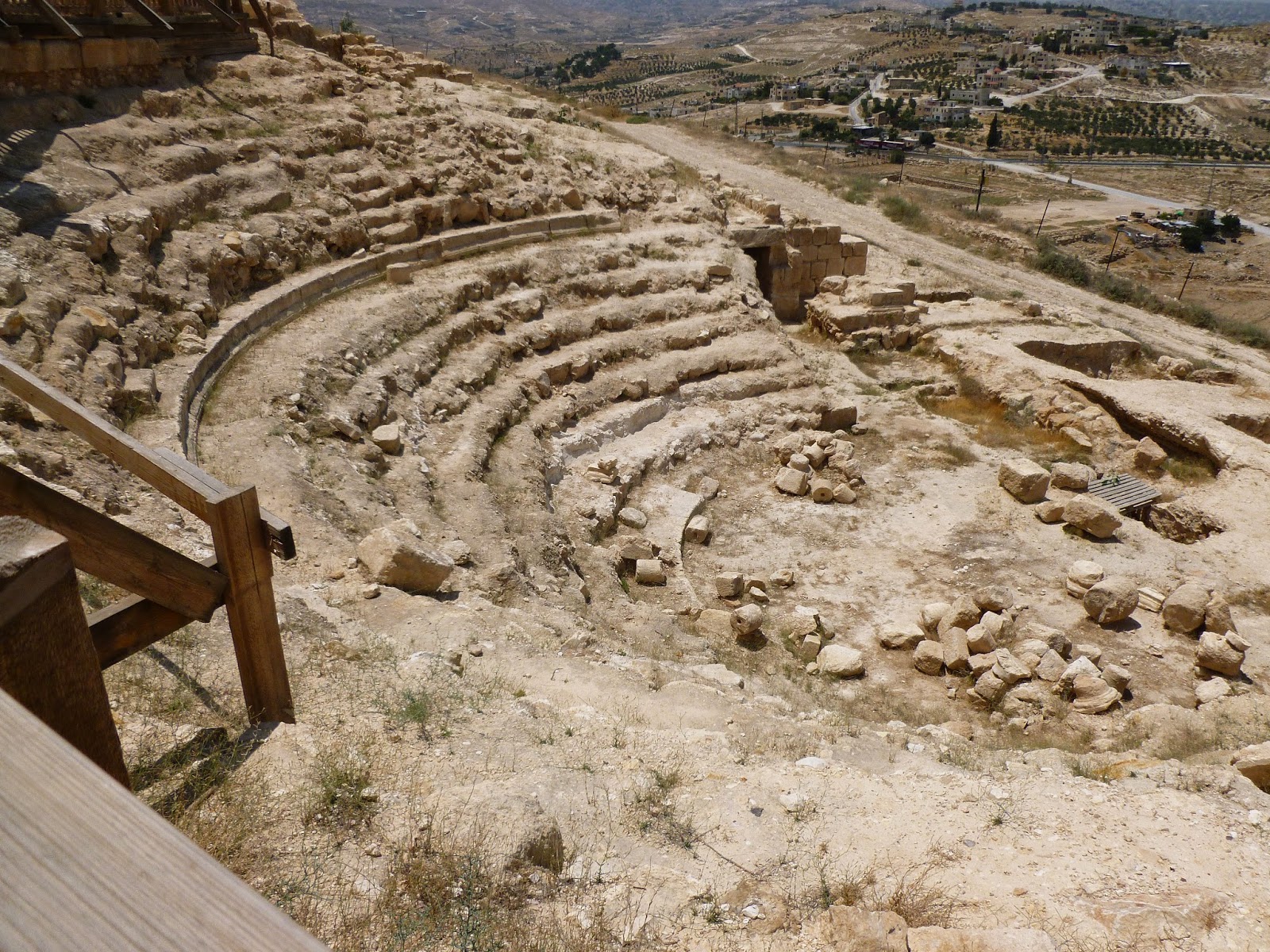
Construction involved not only building a small mountain, but the palace/fortress at the top, a swimming pool (bigger than Olympic size), a theater, and the future tomb for Herod, but also an aqueduct to bring water to the palace.  Yet despite all Herod’s efforts to build great monuments to himself (this was just 1 of 7 palaces he built), it was the baby born within sight of here who changed the world and continues to inspire people to do good in His name.
Theater at Herodium
Entrance to Herod's Tomb - just discovered in 2007

The final official stop for the day was in a local terraced garden.  It was here, sitting beneath the shade of grape vines that we studied the story of the Garden of Eden and the references to all of us as a community being part of the grape vine.  Part of what I really enjoy about this trip (and the last one) is to get a much better understanding of the meanings of the stories in the bible by studying them in the understanding that they were written by Jewish writers, for mainly Jewish listeners, and that Jesus was Jewish.
Being here, and especially thanks to the studies John has done regarding the Jewishness of Jesus and the time, we are able to learn about the unspoken meanings of the bible stories.  So often a word will be used that is hard to translate, but through our discussions we look into the meaning behind it.  Taken in the context of the time and place of the stories, God is portrayed as a much more loving God than is often taught.  He wants us all to have a joyful life, trusting him to provide what we need and helping others understand this too.  I really enjoy having the opportunity to meet so many people of various backgrounds here because the more people I meet the more I see we are all more alike than different.

Altar above the Birth Site
Once we arrived here in Bethlehem we had the opportunity to visit the Church of the Nativity if we wanted to.  Bryan and I headed up there so we could visit and still make it back in time for dinner.  The last time I visited I commented about how the church was falling into disrepair but because the 3 religions who have a stake in the church (Greek Orthodox, Eastern Orthodox, and Catholic) could not agree on how to make the repairs nothing was getting done.  Shortly after that the government declared it a national treasure and ordered them to start fixing it.  So the roof and windows are currently being repaired, but most of the frescoes and the painted columns (painted during the time of the crusades) have been covered to protect them during the reconstruction.  Hopefully they will restore those next, but for now it definitely looks like a place under construction.  It was moving and peaceful to pray there despite the activity going on all around.  I said a special prayer for Mom knowing how she would have loved to have been here.
Add caption

Tile floor from the original church in 327 AD


At the Birth Site


By the end of the day, including our longer than expected walk to the Church of the Nativity, we put in another 4.5 miles (13,000+ steps). Total for the trip: 10.75 miles.  Now off to wash off the dust from today and rest up for tomorrow!